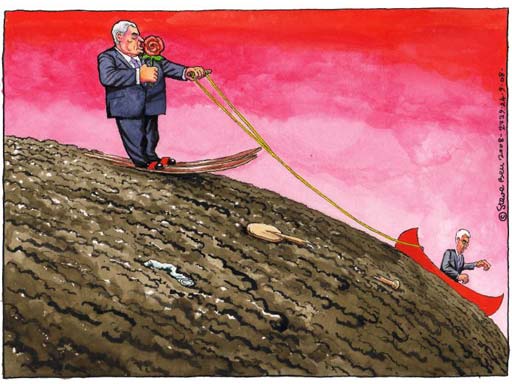
Showing posts with label Professional Cartoonists Organisation. Show all posts

Saturday, January 24, 2009

The Bloghorn has moved


Hello, we moved at the start of the month and now live here. This means we won't be regularly updating here anymore but you can subscribe to our email updates by using this form below. The Bloghorn is run by the UKs Professional Cartoonists’ Organisation.

Enter your email address:

Service delivered by FeedBurner


The PCO: Great British cartoon talent
Subscribe to The Foghorn - our print cartoon magazine

Sunday, January 11, 2009

Bloghorn has moved home


From the 12th January, the Bloghorn will be updating its news from the UK's professional cartoonists at a new home. This will mean we shan't be updating here anymore, and if you bookmark, or, subscribe to any of our services in the right hand column you will need to adjust your preferences from the new site.

The PCO: Great British cartoon talent
Subscribe to The Foghorn - our print cartoon magazine

Monday, January 5, 2009

Lego cartoons

It's the start of the first working week of the New Year, so here's something very silly, and great fun, to cheer you up: Lego cartoons. That's not cartoons about Lego, you understand, but cartoons made of Lego.

US magazine cartoonist Mark Anderson re-created one of his own gag cartoons in Lego form, purely for fun last year. And he's just added another to his plastic-brick portfolio.

Whatever next? Steve Bell re-creating his entire oeuvre in Stickle Bricks?

The PCO: Great British cartoon talent
Subscribe to The Foghorn - our print cartoon magazine

Bloghorn is packing bags

Ross Thomson Cartoon at the Bloghorn for the Professional cartoonists' Organisation
The Bloghorn will be moving home next week.
The PCO: Great British cartoon talent
Subscribe to The Foghorn - our print cartoon magazine

Friday, January 2, 2009

The cartoonist in 2009

Preparations for the Shrewsbury Cartoon Festival 2009 are well under way.

This year's festival theme is The Science of Nature to coincide with the town's year-long celebration of Shropshire lad Charles Darwin’s birth. This year also coincides with the 150th anniversary of the publication of his book On the Origin of Species.

The Guardian’s Steve Bell will be exhibiting his unique take on “Anthropomorphism”; expect monkeys, Dubya, penguins, Blair, Brown and more.

There will be an exhibition of historical science cartoons from the nineteenth century that Darwin himself is likely to have have seen. These have been borrowed from collections at the University of Kent at Canterbury, the British Museum print room and the National Cartoon Museum. Curation is by Adrian Plant at the Shrewsbury Museum and is underway now.

And there will be a visiting exhibition from internationally regarded Czech cartoonist Miroslav Bartak who draws jokes from the miracles of modern science.

A spokescartoonist for the organising committee offered Bloghorn this quote:

"The funding is, as ever, as tight as grandma on the absinthe, but the all-hands-to-the-wheel attitude of the stout yeomanry on the ground will bring a fat ray of sunshine into next April’s showers. The festival weekend is the 24th-26th April 2009 although the exhibitions will run through April."

Bloghorn would like to urge any commercial enterprise interested in associating their name with the potent mixture of large crowds, extreme levity and high seriousness to contact the organisers from here.

The PCO: Great British cartoon talent
Subscribe to The Foghorn - our print cartoon magazine

Wednesday, December 31, 2008

Bloghorn's cartoon reviews of 2008 – and looking forward to 2009

Tayo Fatunla for the BBC World Service (Also, including Zapiro from South Africa).
Kipper Williams at the Guardian. The paper also offers a wide selection of art for the new year including Martin Rowson and Steve Bell.
Political cartoonist of the Year Morten Morland at the Times.
Pat Blower draws for The Daily Telegraph.
Matt Buck Hack cartoons for Channel 4.
And, Christian Adams of the Telegraph revisits the classic old and new year image.

The PCO: Great British cartoon talent
Subscribe to The Foghorn - our print cartoon magazine

2008 - a look back at St Just

PCOer Alex Noel-Watson reports on last year's version of one of the drawing things we have to look forward to in 2009:

Deep in the heart of the French countryside of the Limousin, in the department of Haute Vienne where characteristic tan-coloured cattle roam the lush meadows, nestles the village of Saint-Just-Le-Martel, near Limoges.

Saint-Just-Le-Martel could be described as the unofficial world capital of cartoons, thanks to the vision and energy of its mayor, Gérard Vandenbroucke, who 26 years ago started the annual Salon International de la Caricature, du Dessin de Presse et d'Humour.

St Just cartoonists @ The BloghornThe Salon runs for ten days at the end of September and beginning of October, and approximately 200 cartoonists converge upon the village from all over the world, 100 for the first weekend and the remainder for the second. A small number of cartoonists stays for the whole ten days. All the cartoonists who attend the Salon are happily billeted with local families.

The Salon is the biggest exhibition of cartoons in Europe, probably the world. The vast main exhibition, displaying cartoons from every imaginable country, is supplemented throughout the Salon site and beyond (in Limoges) by numerous others.

This year these included the historic works of Daumier, a presentation revealing the astonishing versatility of the veteran French cartoonist, Roger Mofrey, exhibitions by Brito, Avoine, Tignons, Kerleroux, Cambon, Puig-Rosado and others; caricatures by Nalair, a large display of caricatures by Sterpone, Moine and others in the main area; the Cartooning for Peace exhibition, conceived by Plantu and already shown at the United Nations in New York and around the world, most recently in Jerusalem, Hollon, Bethlehem and Ramallah; cartoons from Québec, Cuba, Turkey, Portugal and Germany.

Saint-Just, however, is not resting on its laurels. For a long time Gérard Vandenbroucke has nursed the ambition to build a permanent world centre of cartoons. This dream is nearing fruition. Two years ago, the first symbolic bricks were laid, and Gérard told me that construction will begin at the end of this year.

"There will be 18 months of building works and the centre will be officially opened in 2010," he said.

The PCO: Great British cartoon talent
Subscribe to The Foghorn - our print cartoon magazine

Friday, December 26, 2008

Bloghorn Artist of the Month - Denis Dowland

Bloghorn and Denis Dowland cartoon
Reflecting on the future of cartooning in the digital age in our last entry for 2008, PCO Artist of the Month, Denis Dowland, writes:

Technological advances give with one hand and take with the other just like chancellors. I certainly do not miss the good old days of dragging heavy portfolios round studios, at or soon after lunch-time, to baffle brain-addled, red-braced juvenile yuppie editors, I'd better stop now, it's all coming back to me. I simply couldn't wait for the internet.

Now that video has virtually taken over the medium, however, the internet is swamped by infantile trash, taking us back to square one, if not further. This only requires an upgrading of our working methods, like the telephone once did. The threat I see as more insidious is the unstoppable drive toward the cretinisation of society as perhaps its only means of holding together, its naturally enthusiastic adoption by the mediocre and its resigned and guilty acceptance by those who do know better. Grumpy old git, moi? I love it.

The PCO: Great British cartoon talent
Subscribe to The Foghorn - our print cartoon magazine

Tuesday, December 23, 2008

Season's greetings from the Bloghorn and the PCO

Bloghorn Christmas card 2008 from the UK Professional Cartoonists’ Organisation
The PCO: Great British cartoon talent
Subscribe to The Foghorn - our print cartoon magazine

The spirit of Christmas

PCOer Clive Collins writes:

Some years ago I received a letter from the USA, from a lad of 14, who loved cartoons. He said he admired my cartoons (sic) and that he would dearly love to be a cartoonist, but that seemed an impossible dream, so might I oblige him with a small drawing, or signature, so he could compile a book of his heroes. I duly obliged and despatched a small signed self-caricature.

A couple of years later, and another letter arrived, from this same boy – who had remained miraculously 14 - with the same request. I ignored this one, and thought no more about it until, a while later, a package arrived containing 100 sheets of C5 blank paper, and a note stating that as I was obviously too busy, could I please pass round the sheets among my fellow cartoonists for them to do a drawing and/or signature for the book of cartoon heroes.

At this point I contacted cartoonist Mell Lazarus in the USA and asked him if he had ever heard of this boy. I could almost hear the acid laughter floating upon the water between us, when he replied that the ‘boy’ was well-known to American cartoonists, and in fact was a middle-aged lawyer who made quite a living, buying and selling original sketches and signatures at specialist auctions held all over the States. The Americans had given this guy the bum’s rush, and he guessed that now it was our turn. There was a son but he had grown up.

The PCO: Great British cartoon talent
Subscribe to The Foghorn - our print cartoon magazine

Monday, December 22, 2008

Santa Claus and the cartoonists

The Bloghorn, digital diary, UK professional CartoonistsPCOer Chris Madden writes:

The exact origins of Father Christmas (as opposed to Santa Claus) are lost in time: he was probably a pagan personification of midwinter, who put in an appearance around the solstice on December 21st. Indeed, he may well have been one and the same person as the old bearded man with the scythe and hour-glass, Father Time, who turns up at New Year, a week or so after Christmas is over (and once he’s slept off the sherry and mince pies). Father Christmas was a central character in Britain’s seasonal festivities long before Santa Claus joined in the celebrations. Santa didn’t really participate in the fun until the nineteenth century. However, once Santa put in an appearance he soon pushed the original Father Christmas into the background. Why? Because Santa was an American. Or, to be more precise, an American descendant of Turkish ancestry.

The original Santa Claus was Nicholas, a 4th century bishop of Myra in Turkey, who reputedly handed out gifts to children. (Very suspicious, if he were around nowadays there’d be a heavy police file and, possibly, an electronic tag around his ankle.) The bishop remained relatively obscure for fifteen hundred years or more until his star suddenly rose in the nineteenth century.

St Nicholas entered popular culture in the United States when, in 1809, the novelist Washington Irving (who wrote Rip Van Winkle) penned a satire on the Dutch culture of New York (a city that had a strong Dutch element in its history – so much so that it was originally called New Amsterdam). In his satire he referred to Saint Nicholas by his Dutch name of Santa Claus and portrayed him somewhat like an elfin Dutch burgher with a clay pipe.

A few years later, 1822, Dr. Clement Clarke Moore, a professor at a theology college in New York and the son of the Bishop of New York and his heiress wife (the family were so rich that the college at which Moore taught was built on their own estate), read Irving’s book and published a poem based on the Santa Claus character: “Twas the night before Christmas, when all through the house, not a creature was stirring, not even a mouse.” The poem became a great hit: you may be familiar with it yourself (or at least with its opening lines). It was in this poem that Santa first acquired his reindeer. Before this he had to make do, somewhat bizarrely, with an eight-legged flying horse.

At this point the Santa industry went stratospheric. With the poem as inspiration, the cartoonist Thomas Nast started to draw the first of what would eventually be more than two thousand illustrations for Harper’s Weekly magazine depicting Santa. Nast's early depictions of Santa showed a rotund gent of quite serious demeanor, becoming more jovial over the passing years. This Santa was closer to Washington Irving’s version than the usual stern bishop of previous tradition. Nast also gave Santa his headquarters at the North Pole and his army of toiling elves.
Here's Nast's first depiction of Santa, from Harper's Weekly of 3rd January 1863 (which also included another, much smaller illustration of Santa by Nast).

Thomas Nast draws Santa Claus for Harper's Weekly @ The Bloghorn

Judging by this illustration you may think that Santa's wearing a rather festive outfit, festooned with Christmas stars - however, if you look at the original drawing you'll see that he's sitting beneath a Union flag. The suit - with its starry jacket and striped trousers - represents this flag. If the illustration had been in colour the jacket would have been blue (I bet you assumed that it was red), reflecting the colour of the ground behind the stars on the flag, while the trousers would be red and white stripes. Nast was essentially a political cartoonist - and in political cartoons wrapping a character in a flag to signify their allegiance is quite common.
At the time that Nast created the illustration the American civil war was in progress. Nast was on the Unionist side. The puppet in Santa's hand bears an uncanny resemblance to Jefferson Davis, the president of the Confederate states of America whom the Unionists, or Federal states, were fighting.

It was essentially Nast’s imagination that gave us the Santa that we know today – except, that is, for his red coat with white trim. Santa reputedly wears a red and white outfit because they are the corporate colours of the Coca Cola Corporation, who enlisted Santa to promote their fizzy drink in the 1930s. The Coke ads were created by an American commercial artist of Swedish ancestry, Haddon Sundblom, who modelled his Santa on his friend Lou Prentice, chosen for his cheerfully rotund features.

So it is that Santa Claus doesn’t actually come from the North Pole but from New York city, and he doesn’t date from the birth of Christianity two thousand years ago but from the early days of capitalism in the mid-nineteenth century.

The PCO: Great British cartoon talent
Subscribe to The Foghorn - our print cartoon magazine

Wednesday, December 17, 2008

The Big Draw banners for sale

Back in November we blogged about the PCO's team for Transports of Delight – a cartoon banner competition held at St Pancras rail station in London as part of the The Big Draw.

Well, now you can own a piece of cartooning history as the four banners in the competition (from The Guardian, The Independent, Private Eye and the PCO) are being auctioned off on eBay, with all proceeds going to the Campaign for Drawing, a charity whose purpose is to promote drawing as a tool to support learning, and cultural and social engagement for all ages and abilities.

The Independent cartoonists at the Big Draw 2008The winning banner from The Independent (Dave Brown, Tim Sanders, Chris Burke and Bloghorn Editor Matt Buck)

The Guardian cartoonists at the Big Draw 2008The Guardian (Steve Bell, Martin Rowson, Tim Pond and PCO Chair leg Andy Davey)

The Private Eye cartoonists at The Big Draw 2008 Private Eye (Andrew Birch, Richard Jolley, Simon Pearsall and Ken Pyne)

The Bloghorn cartoonists from the PCO at the Big Draw 2008and last but not least the Professional Cartoonists' Organisation (Pete Dredge, Robert Duncan, Kipper Williams and Bloghorn writer Royston Robertson)

Hurry though, if you do want to make a bid, as the auctions end on the evening of Monday 22nd December!

The PCO: Great British cartoon talent
Subscribe to The Foghorn - our print cartoon magazine

Sunday, December 14, 2008

Goodbye big print (and cheerio President Bush)


PCOer Andy Davey writes:

One thing that all cartoonists are very aware of is that the face of publishing has changed. Much of it has been a little scary for established old-media cartoonists, but one of the undoubted benefits of the new trends has been on-demand printing.

While there’s still a need for hard copy (books for fireside, on train, lining impressive bookshelves, in tent up mountain etc), self-publishing sites provide the bridge between the mature and the new by converting digital files into comforting, heart-warming, cuddly books to be held and cherished.

An example, I hear you ask? Oh, if you insist. You could, for example, check out a short cartoon booklet called Bush Combat by UK cartoonist Andy Davey (see it here). This was published, like fellow PCO cartoonist Ger Whyman’s book on the self-publishing site, Lulu.

The book covers the pugilistic adventures of the boy George Dubya, from early spats with the UN, through the horrors of Iraq, right up to his search for a legacy in the Middle East. The time seemed right; it is meant as a last post to his disastrous tenure in the White house. The editorial cartoons all have brief explanations for those with medium-term memory loss; they were mostly published in The Guardian, The Times and The Independent over the last six years. Some are previously unpublished. It’s long on pictures and short on text, so even Dubya himself could order one and understand it … possibly.

The PCO: Great British cartoon talent
Subscribe to The Foghorn - our print cartoon magazine

Friday, December 12, 2008

Bloghorn Artist of the Month - Denis Dowland

Bloghorn, Denis Dowland cartoon, UK cartoonist, Professional Cartoonists’ Organisation
PCO Artist of the Month, Denis Dowland, reveals to Bloghorn how he goes about producing his cartoons ...

"I have had to learn to resist the Big Creative Rush, especially after a grand meal or closing time, when everything comes out so clear and sharp and you can do, of course, no wrong.

"I have to let most ideas stew for some considerable time, we're talking months here, mostly, before I commit them to paper, or nowadays the computer, lest I look at a page in total bafflement as to what on earth I may have had in mind the night before. I think something similar happens to Gary Larson on occasion.

"Once the idea is fixed it's like painting by numbers. I love having just finished a picture but doing it is a grind; a common enough malaise."
There will be more work from Denis next Friday.

The PCO: Great British cartoon talent
Subscribe to The Foghorn - our print cartoon magazine

Thursday, December 11, 2008

PCOer Morten Morland wins political cartoonist of the year


PCOer Morten Morland won the Political Cartoon Society's cartoonist of the year yesterday. Bloghorn is publishing one of Morten's Post-it note caricatures of Gordon Brown above.

Bloghorn's alter ego, and the current chair leg of the PCO, Andy Davey said:

It's great that Morten has won this. He's one of the best cartoonists working in the UK. The judges commended his immediately recognisable style and use of unusual perspective - I'd second that. And he does it all with only one real outing in the UK media per week - watch Mondays in The Times newspaper.
Steve Bell, of The Guardian, won best single image of the Year, for something like this and Peter Shrank of The Independent on Sunday was runner-up.

Morten has a word at his blog.

Christian Adams has a report here too.

The PCO: Great British cartoon talent
Subscribe to The Foghorn - our print cartoon magazine

Wednesday, December 10, 2008

Cartoonist takes issue with cartoon awards


Everyone likes an online row, and cartoonist Rod McKie has provoked one on his blog with a blast at the recent Cartoon Art Trust Awards. (We blogged it here.)

Rod is an established professional cartoonist, well known for his forthright opinions. In this article he dismisses the entire genre of caricature (“It’s a fairly tired old medium now, isn’t it?”) and all political cartoonists (“They are all cowards who row-in with the ideology of the press barons they work for”). His particular beef against the CAT awards is that they are an “insular, parochial, London-based affair”, and he doesn’t appear to value many of those who won awards. Cartoonists have pitched in on his blog – including one of the award recipients – some agreeing and others disagreeing.

Bloghorn takes the view that anyone who sets up an award and is prepared to pay for the preparations, gets to choose how to judge it. You may not agree with their choices, but isn’t this always the way with awards ceremonies? Look at the grumblings that surround the Oscars every year.

But we are prepared to defend the Cartoon Museum itself, which is run by the Cartoon Art Trust. The museum, which receives no public funding, is among the most popular small museums in the country. There are some visitor reviews available here. Rod says the CAT has "never appeared on my radar" and adds that he knows nothing about the museum, as if that justifies his dislike.


Cartoon Museum workshops cover cartooning in all its forms. Pic: Cartoon Museum

The London museum may seem irrelevant to a cartoonist based in Scotland, but if he did make a trip, he would find that they do some great work, and it’s not all about joke and political cartoons or caricature. Look at the work that cartoonist Steve Marchant does there, running endless workshops and creative classes for young people. These cover comics, graphic novels and manga … the works.

We also take issue with the notion that cartoons that appear in British newspapers and magazines are somehow “parochial”. Rod seems to be of the view that in a globalised economy all cartoons should appeal to the whole world. We argue cartoons should reflect the real lives and experiences of people and any attempt to homogenise them for a world audience would be bad for cartooning as a whole.

Discuss. All comments welcome. Comment moderation is turned on.

Royston Robertson and Matt Buck

Updated at 3pm 9th December 2008:
The Cartoon Museum has kindly sent details of its visitor numbers since Britain's first dedicated museum to the art of the cartoon opened in February 2006. Curator Anita O'Brien reports that from the time the museum opened in February 2006 until the end of 2006 it had 17,653 visitors. During 2007 this rose to 24,110 and to date in 2008, 27,410.

The PCO: Great British cartoon talent
Subscribe to The Foghorn - our print cartoon magazine